What Your eBay Fee Calculator Leaves Out: Shipping, Promoted Listings, and Sourcing Cost
October 17, 2026
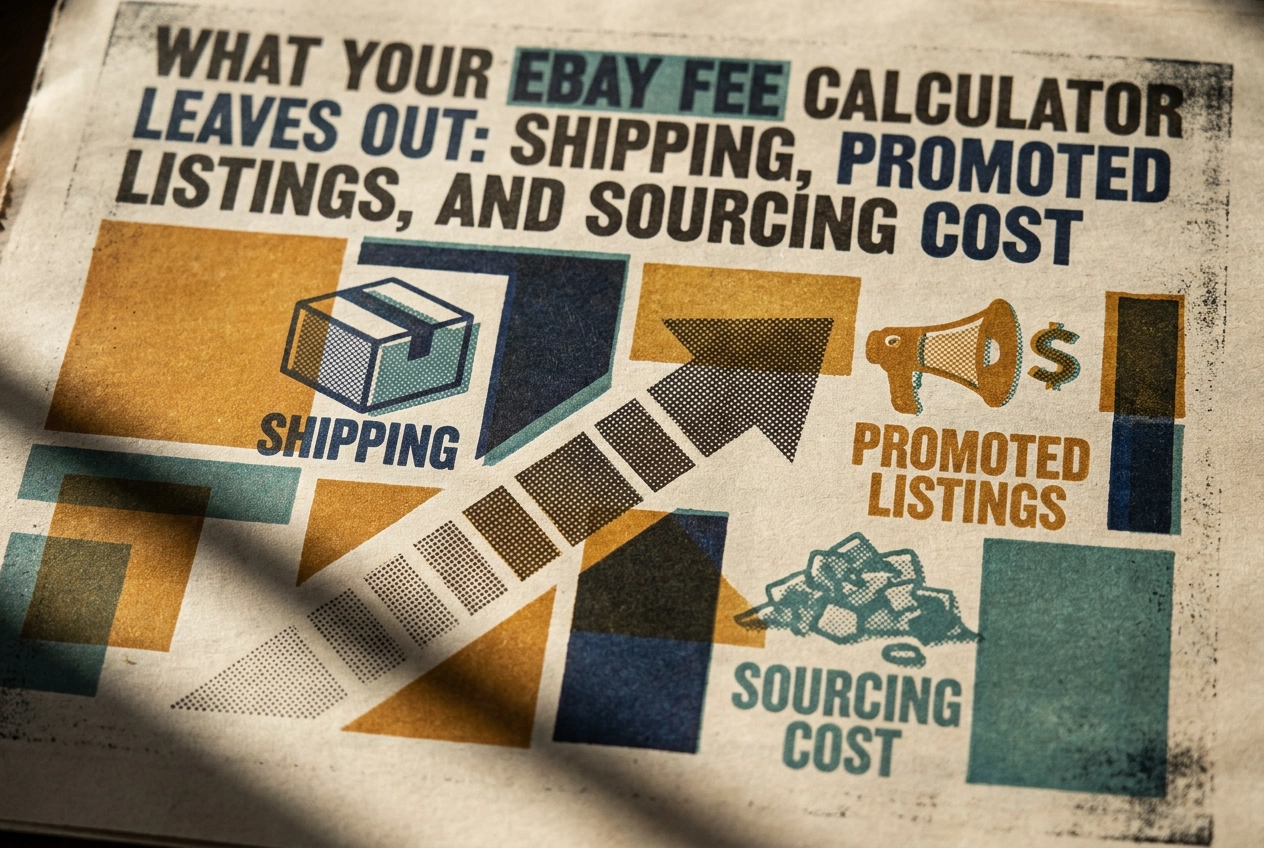
You have run the numbers through an eBay fee calculator. The final value fee looks manageable. The margin looks healthy. So why does your bank account disagree?
Here is the uncomfortable truth: a fee calculator answers only one question, what eBay takes from the sale. It does not tell you what you keep. When sellers treat that commission figure as the final word on profitability, they risk overlooking the gap between what eBay takes and what actually lands in their pocket, a gap that widens with every cost the calculator never sees.
This tutorial reframes the calculator as step one of a five-cost equation. You will learn why a fee calculator is only the beginning, then work through each cost layer it never sees: sourcing cost, inbound shipping, outbound shipping, promoted listings spend, and the late-arriving expenses of supplies and returns. You will also see a full landed-cost walkthrough where a profitable calculator result turns negative, and you will learn how to build a per-item cost basis you can maintain. By the end, you will treat the calculator as a starting point, not the answer.
Why a Fee Calculator Is Only Step One of the Profit Equation
You type a sale price into a fee calculator, read the final value fee, subtract it, and assume the rest is yours. That tool answers a marketplace-commission question. It does not answer a profit question.
eBay's help documentation describes what the calculator computes: two main fee types, an insertion fee at listing and a final value fee at sale. Amounts depend on price, format, category, listing upgrades, and seller conduct and performance. Store subscribers, vehicle sales, and eBay Live sales sit under different fee structures.
The missing piece is your per-item cost basis: the total landed cost to get one unit listed, sold, shipped, and kept by the buyer, divided by that unit. Five costs build it: sourcing cost (COGS), inbound shipping to your location, outbound shipping to the buyer, promoted-listing spend, and supplies plus returns. Each is invisible to the calculator and each moves real dollars out of the sale.
Later, you will see how a fee-only result on a $100 sale turns much worse once the other costs stack on top. Rates change, so confirm them on eBay's help pages first. Operationally, a missing cost basis means re-buying decisions rest on a number that was never profit, so dead inventory gets replenished. Simple Pricing. No Surprises. keeps landed cost visible.
Cost One: Sourcing Cost, the Number Most Sellers Guess At
Sourcing cost is everything paid to get a unit onto your shelf: auction or lot price, estate sale, retail arbitrage, storage-unit bid, or one item's share of a bulk lot. Bulk lots are where unit cost breaks down. A $200 pallet of 40 items averages $5 per unit, but if only 10 are resellable and 30 are duds, those 10 carry the whole $200, about $20 each before shipping. On a $30 sale, a $5 basis leaves $25 for fees and shipping; a $20 basis leaves $10.
This is the calculator's structural blind spot: it takes sale price as its input and has no field for what you paid. The largest variable in the profit equation never enters the math. Two sellers can list the same item at the same price and only one makes money, because only one knows the cost basis.
Accounting tools offer COGS tracking now, but that is bookkeeping after the fact. It does not tell you whether to buy the next pallet. Start with capture: log the purchase price at acquisition, including per-unit splits of lots, so the number exists before the item is listed. AI Reseller Pro keeps those records attached to each item. No reliable figure exists for how many sellers skip this step; the arithmetic above is the argument.
Cost Two: Inbound Shipping, the Cost of Getting Inventory to You
Sourcing cost is only the first layer. The money you pay to move goods from the source to your storage is the second. Inbound shipping includes wholesale freight, per-box charges on auction wins, travel and fuel for local sourcing runs, and freight-in costs that accounting systems treat as part of inventory value, not as a generic expense (this principle applies under common accounting standards; confirm the treatment that applies to your business with a tax professional).
Treat it as its own line, not a rounding error. On low-cost goods, freight can equal or exceed the purchase price. A $3 item bought online with $6 shipping is a $9 item.
Multi-item shipments require allocation. A flat-rate box of 25 sourced items costing $18 to receive puts $0.72 on every unit. That $0.72 belongs in each unit's cost basis, not in a vague year-end "shipping" bucket. Fee calculators model the buyer-side transaction only. Nothing in the tool accounts for costs incurred before an item is even listed.
Tracking rule: log freight-in per shipment, divide by usable units, and add that figure to the unit's sourcing cost so it becomes one COGS number. AI Reseller Pro keeps those landed-cost components attached to inventory records instead of a separate spreadsheet.
The common failure mode is counting only the outbound label and never the freight paid to receive goods. That omission quietly inflates perceived margin on every unit in that shipment; outbound shipping compounds it.
Cost Three: Outbound Shipping and What the Fee Base Actually Includes
Outbound shipping is the label, packaging weight, carrier surcharges, dimensional-weight adjustments on bulky items, and any free-shipping subsidy you absorb. eBay's final value fee base is calculated on the full amount the buyer pays, including shipping; verify the rule and rates on eBay's help pages. Shipping is charged twice: once as a real cost, once as fee-generating revenue.
A buyer pays $40 plus $8 shipping on an item that costs $7 to ship. The fee applies to $48. At a typical 13.6% category rate that is about $6.53, plus a per-order fee, near $6.90. You paid commission on money that never entered your pocket.
Free shipping compounds it: build postage into the item price and you still pay the label and still pay commission on the inflated price.
Track per item: actual label cost, dimensional-weight surprises, regional rate differences, and the gap between what the buyer paid and what the label cost. Log label cost at the moment of sale against shipping collected so each item carries a true shipping delta, not a remembered average. AI Reseller Pro attaches per-sale shipping figures to inventory records, keeping that delta visible after the sale.
Cost Four: Promoted Listings Spend You Forgot to Count
Promoted-listing spend is the ad rate paid to place listings in front of buyers. eBay charges a percentage of the total sale amount when the promoted item sells; confirm the exact mechanics and rates on eBay's help pages. Vendor fee guides list promoted-listings fees as a separate line item beside final value fees, regulatory operating fees, and below-standard or high-return penalties.
Unlike sourcing cost, ad spend is rarely tracked per item. A 6 percent ad rate on a $40 item takes $2.40. You remember the rate you set months ago, not the per-unit charge. Promoted fees are charged separately from the final value fee, confirm the stacking on eBay's help pages, so one sale may carry both marketplace commission and the ad percentage, and neither number appears in a fee-only calculation.
Record the ad rate and promoted fee per sale, not as a monthly total, so promoted spend attaches to the specific unit and listing that generated it. Rates change and eBay periodically revises its Promoted Listings structure, so confirm current terms on eBay's help pages.
Promoted spend earns its place only when margin supports it: a unit with 20 percent gross margin cannot absorb a 10 percent ad rate without going negative. AI Reseller Pro keeps promoted spend tied to individual listings and sales, so ad cost sits alongside sourcing and shipping.
Cost Five: Supplies and Returns, the Costs That Show Up Late
Ad spend is not the last hidden cost. Supplies are the physical overhead behind every shipment: boxes, polymailers, tape, labels, void fill, bubble wrap, and printer consumables. Supplies add a real per-shipment cost, boxes, polymailers, tape, labels, void fill, and printer consumables, that varies by item type and volume. Individually trivial; across hundreds of shipments the total compounds into real money.
Returns cost three ways: the refunded sale price, the outbound label you never recover, and the return label you may pay. Restocking adds more. A return erases the sale price while your sourcing cost, inbound freight, supplies, and original label stay spent. Example: a $40 sale with $12 sourcing, $3 inbound freight, $7 outbound label, and $1.20 supplies leaves about $23 of sunk cost before any return-label charge.
eBay also assesses performance penalties such as Below Standard and high return rate status. Vendor guides list these as separate fee line items. Thresholds are worth checking on eBay's seller performance pages; this research does not quantify them.
Track supplies as a fixed per-item allocation and log every return against the original item record. That makes return rates visible by category. AI Reseller Pro records returns against inventory, so the true cost lands on the item that caused it.
The Full Landed-Cost Walkthrough: When a Profitable Calculator Result Turns Negative
Here is one item end to end. The buyer pays $40 plus $8 shipping, so $48 changes hands. Your allocated sourcing cost is $12, inbound freight $3, the outbound label $7, promoted listings at 6 percent ($2.40), supplies $1.20. All rates are illustrative. Confirm current figures on eBay's help pages.
A fee calculator sees only the $48. At a typical category rate of 13.6 percent plus $0.40 per order, final value fees land near $6.93, leaving $41.07. That looks healthy. This is exactly where the overestimation begins.
Now subtract what the calculator never asked about, tracking the running total:
Sourcing $12 → $29.07
Inbound freight $3 → $26.07
Outbound label $7 → $19.07
Promoted spend $2.40 → $16.67
Supplies $1.20 → $15.47
Then returns. If this category returns at 10 percent, expected per-item cost is roughly 10 percent of the $15.47 running margin, about $1.55. Adjusted margin: roughly $13.92.
Break-even sits near $22.62. The seller would have listed at $40 on the calculator's word alone. The gap is about $17.
The calculator's answer is the fee, the seller's answer is the net, and the difference between them is the five costs the tool never asked about.
How to Build a Per-Item Cost Basis You Can Actually Maintain
The walkthrough above proves the arithmetic. Maintaining it takes a routine.
Capture sourcing cost at acquisition: enter what you paid, including allocated lot splits, before listing. That math only exists while the receipt or lot breakdown is in front of you. Split lots by resale value and apply one method consistently.
Add freight-in per shipment: divide inbound freight by usable units and fold it into unit cost. Freight-in is generally recoverable as inventory cost as goods sell, confirm the applicable rule in IRS Publication 334 or with a tax professional, so it belongs in COGS, not a year-end shipping bucket.
Set a fixed supplies allocation: pick a per-shipment figure and apply it to every sale. Boxes and tape stop being invisible.
Record outbound label cost at the moment of sale: compare it to shipping collected. The delta per item is known, not assumed.
Attach promoted spend and returns to the item: log the ad rate and ad fee per listing; log each return against the original unit. Ad rates and return rates then get judged by category, not in aggregate.
Review margin by item and category monthly: use that review to decide what to buy next. Here a cost basis stops being bookkeeping and becomes sourcing strategy.
AI Reseller Pro keeps sourcing, listing, inventory, and profit data in one place for eBay and Whatnot live selling.
Conclusion: Treat the Calculator as Step One, Not the Answer
The calculator's commission figure is useful, it is the first line of the five-cost equation, not the last. Sourcing cost, inbound shipping, outbound shipping, promoted-listing spend, and supplies plus returns sit outside its math, and returns add a sixth adjustment for the expected loss on units that come back.
The six-step routine in the previous section puts all five costs into a maintainable basis before the next sourcing run.
Confirm the rates first. Final value fees, per-order fees, ad rates, and performance penalty thresholds change and vary by category and store status, so check eBay's help pages before acting on any figure here.
The real payoff is not cleaner accounting. It is knowing which inventory to stop buying. Keep sourcing, listing, inventory, and per-item profit in one system, so the landed-cost number is there when you decide to buy, not months later at tax time.